

How to train more often per week without getting injured in BJJ or Grappling?
There comes a time when everyone who trains BJJ or Grappling reaches the same point:
You want to train more.
You want to roll more days.
You feel like you could improve faster…
But your body doesn't respond the same way.
Aches and pains start.
Pain in knees, elbows, neck.
Accumulated fatigue.
And without realizing it, you go from wanting to train more… to having to stop.
The one who trains the hardest doesn't win, but the one who can train for longer without breaking down. In this article, we explain it.

1. The most common mistake: training hard every day
Many practitioners think that improving means giving 100% in every session.
But the body doesn't work that way.
Training hard every day without control causes:
- Muscle overload
- Joint stress
- Nervous system fatigue
- Increased risk of injury

2. How to organize your training week without destroying your body
There's something almost all of us do when we start (and many continue to do for years):
Go to train whenever we can… and always do it the same way.
Same pace.
Same intensity.
Same goal: give it your all in every sparring session.
And at first, it works. You feel strong, motivated, eager to improve quickly. But over time, something starts to happen: your body stops keeping up.
You feel slower.
It's harder to react.
You finish training more tired than usual.
And those persistent aches and pains start.
It's no coincidence.
It's a lack of structure.
Most practitioners don't organize their week. They simply train. And while that seems positive, it's actually one of the biggest mistakes you can make if you truly want to progress.
Because you're not the same every day.
And not all training sessions should be the same.
There are days when, yes, you need to push hard. Roll strong, challenge yourself, test yourself against people better than you, and leave the mat knowing you've given your maximum.
But there are also days when what helps you improve the most isn't winning the sparring, but understanding what you're doing. Repeating a position, working on a guard, moving calmly, correcting mistakes.
That's where many fail.
They believe that training harder means training better.
And that's not the case.
When you organize your week with a little sense, everything changes. You start to notice that you arrive fresher for important training sessions, that you learn faster, and that your body handles the volume better.
You don't need to do something perfect. Just understand one thing:
Not every day is for fighting at full intensity.
Alternating hard days with more technical or lighter days doesn't mean you train less. It allows you to train more… and for a longer time.
How to apply it starting this week
You don't need a perfect plan. Just start training with more intention.
Define 2 or 3 days where you're going to give your all in sparring. Those will be your hard days. The rest of the week, don't try to compete in every training session. Take advantage to work on technique, move with more control, and improve details.
Before each session, ask yourself a simple question:
"Am I here to win or to improve today?"
If you come to win every day, you'll end up tired, injured, or stuck.
Also, learn to listen to your body. If you feel fatigue, pain, or lack of reaction, that day is not for intensity. It's for slowing down and continuing to progress without forcing it.
You don't need to train at 100% all the time.
Training most days at 70–80% will allow you something much more important:
to be able to train more times… for a longer time.
3. The areas that suffer the most (and why you should start taking care of them before they hurt)
In BJJ and Grappling, there are areas that are constantly working, even when you don't realize it. They don't fail overnight. They wear down little by little… until they start to limit you.
And the worst part is, when they really hurt, it's already too late.
Knees
The knees are involved in almost everything: passing guard, playing from the ground, standing up, changing direction, or simply maintaining pressure.
The problem is that they often work at uncomfortable angles, with weight on them and in unnatural situations. It's not uncommon to start feeling discomfort after weeks or months of constant training.
At first, it's just a sensation. Then it turns into discomfort. And if you don't do anything, it ends up affecting your way of moving.
Taking care of your knees is not optional if you want to train long-term.
Elbows
The elbow is one of the most punished and least protected joints.
Every time you frame, push, brace your arm, or resist an armbar, your elbow is working. It doesn't usually hurt suddenly, but it accumulates a lot of load.
That overload is what eventually takes its toll.
You start to feel sensitivity, then discomfort… and one day you realize that you no longer support yourself the same way or avoid certain positions.
Neck
The neck is always under tension. Defending against pressures, avoiding controls, resisting pulls.
And yet, almost no one trains or takes care of it.
This makes it one of the most vulnerable areas. A weak or fatigued neck not only increases the risk of injury but also directly affects your performance.
A strong neck makes you more resilient and harder to control.
That's why more and more fighters are incorporating small aids into their training:
- Knee pads to reduce impact and provide stability
- Elbow pads for protection during bracing
- Tape to reinforce joints
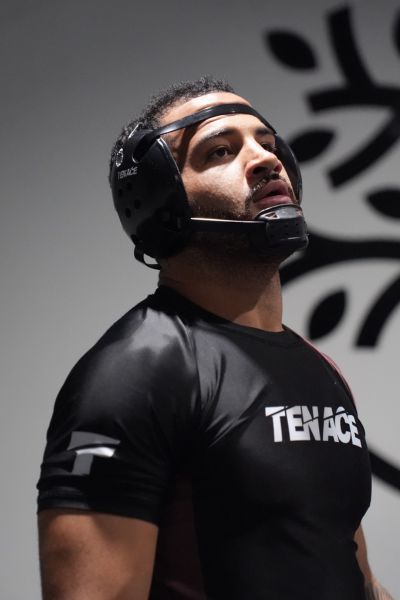
- Ear guards to prevent cumulative injuries

4. Strength training
Many practitioners only train on the mat. And for a while it works… until the aches, lack of stability, and feeling that the body isn't responding the same way start.
The problem isn't BJJ.
It's that your body isn't prepared for so much volume.
Strength training isn't to make you look better.
It's for something much more important:
to be able to keep training without your body limiting you.
What does it provide you?
- More stable knees
- More resistant elbows
- Stronger neck
- Fewer injuries
- More control in combat
What should you train?
You don't need to complicate things. The basics done well are enough:
- Squats
- Deadlifts
- Core
- Pulls
- Pushes
👉 2 days a week make a big difference.
Common mistake
Thinking that just the mat is enough.
Training BJJ without working on strength is like:
driving a lot… without checking the car
Sooner or later, something fails.
5. Warm-up and mobility
It's one of the most ignored parts… and one of the most important.
When you do it well, you notice the difference from the first sparring session. Your joints respond better, you move more fluidly, and you greatly reduce the risk of injuring yourself with a silly movement.
You don't need to overcomplicate it or dedicate half an hour. 10-15 minutes done well is enough. Hip mobility, shoulder rotations, core activation, and some neck work can completely change how you feel when training.
The problem is that almost no one does it consciously. And that shows.
Because many injuries don't come from a bad movement…
they come from a body that wasn't prepared to do it.
If you want to train more times a week, this is one of the simplest and most effective changes you can make.
6. Recovery: training also means knowing when to stop
There's something that's hard to accept at first:
more training doesn't always mean more progress.
In fact, often the opposite happens.
The body doesn't improve while you train.
It improves when it recovers.
If you string together sessions without real rest, you start to accumulate fatigue. You feel slower, less precise, with less energy… and without realizing it, your performance decreases even if you're training more.
That's why learning to stop is also part of training.
Sleeping well, staying hydrated, eating better, and listening to what your body asks for is not secondary. It's what allows you to keep progressing without breaking down.
Many practitioners don't plateau due to lack of effort.
They plateau because they never fully recover.
If you want to train more times a week, you don't need to do more.
You need to recover better.
7. The equipment that allows you to train more

This is where the difference between improvising… or taking it seriously comes in.
There are products that are not "extra".
They are tools to keep going.
Tape
Protects fingers and joints.
Allows you to train even with minor discomfort.
Elbow pads
Reduce impact, friction, and overload on the elbow.
Knee pads
Provide stability and protection in demanding positions.
Leggings / Spats
Prevent chafing, improve hygiene and comfort.
Appropriate backpack
Organization, hygiene, and efficient routine.
It's not about spending more.
It's about avoiding stopping.
